
Temporary Storage During Move Made Simple
May 15, 2026
How to Prepare for Movers Properly
May 19, 2026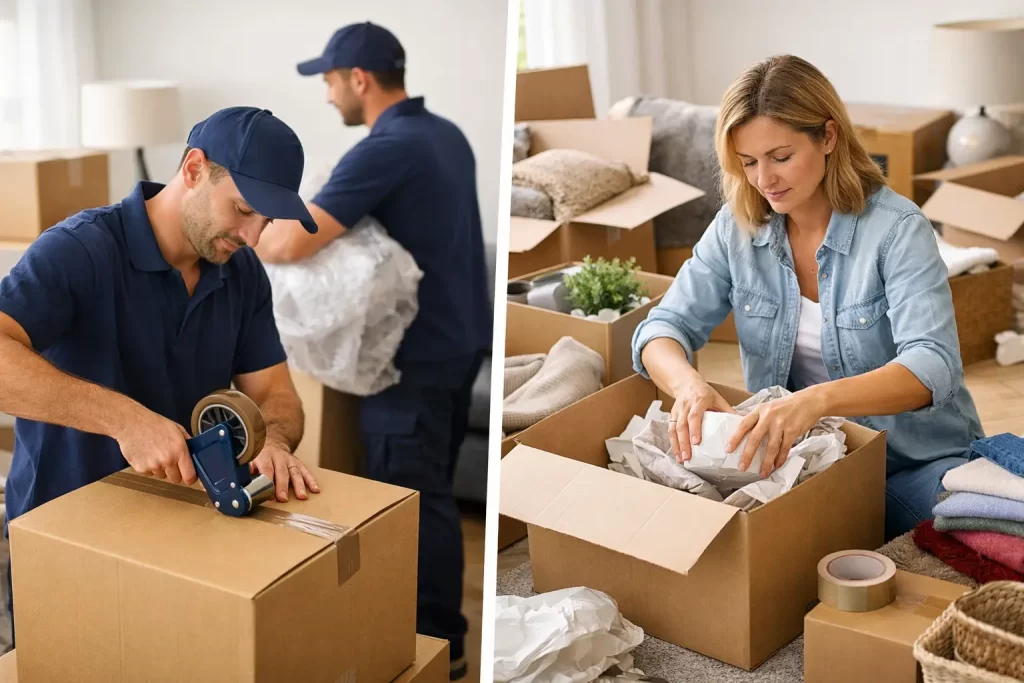
The difference between a smooth move and a stressful one often comes down to the packing. When people compare packing service vs self packing, they are usually weighing three things at once – time, cost and risk. The right choice depends on what you are moving, how quickly you need to be out, and how much responsibility you want to carry yourself.
Some moves suit a hands-on approach. Others are far better handled by trained packers who know how to protect furniture, glassware, electronics and business equipment properly. If you are trying to decide which option makes more sense for your home or office move, it helps to look beyond the upfront price and consider the full picture.
Packing service vs self packing: the real trade-off
At first glance, self packing usually looks cheaper. You buy boxes, tape up your things, label them and do the work in your own time. For smaller moves or low-value items, that can be a sensible choice.
But self packing also shifts the workload and the risk onto you. If something is packed poorly, crushed in transit or takes twice as long as expected, there is no real buffer. You are the planner, packer, quality checker and time manager.
A professional packing service costs more upfront, but it buys speed, consistency and peace of mind. Trained crews work with proper materials, proven packing methods and a system that keeps the move moving. That matters when you have fragile items, a busy household, tight settlement dates or an office that cannot afford delays.
When self packing makes sense
Self packing can work well if your move is relatively simple and you have enough time to do it properly. A small flat, a local move, or a household with mostly durable items may not require full packing support.
It can also suit people who prefer full control. Some customers want to sort every cupboard themselves, decide exactly what gets packed, and use the move as a chance to declutter. If you are organised, not rushed and comfortable lifting the mental load, self packing may be perfectly manageable.
The key point is that successful self packing is not just about putting things in boxes. It takes planning, the right carton sizes, protective wrapping, careful labelling and a realistic sense of how long the job will take. Most people underestimate at least one of those.
The hidden costs of packing yourself
The obvious cost is packing materials. Boxes, tape, butchers paper, bubble wrap, mattress covers and moving blankets all add up quickly. If you buy the wrong materials or not enough of them, you can lose time and money fixing the problem late in the process.
Then there is the cost of your time. Packing an entire home around work, school runs and everyday life is exhausting. It tends to drag into evenings and weekends, and the final days before moving often become far more pressured than expected.
There is also the risk cost. Overpacked boxes split. Underprotected glass breaks. Poorly labelled cartons slow down unloading and make unpacking harder. If office files, IT gear or important stock are packed without a clear system, the disruption can carry on well after moving day.
When a professional packing service is the better option
Professional packing is often the smarter choice when the move is large, complex or time-sensitive. Families moving full households, businesses relocating workspaces, and customers with valuable or fragile belongings usually benefit most.
If you are moving antiques, artwork, TVs, computers, mirrors, kitchenware or awkwardly shaped items, professional packing gives those items a better level of protection. It also reduces the chance of injuries caused by rushed lifting and poor handling at home.
For office moves, packing support is often less about convenience and more about continuity. Desks, monitors, files, phones and shared equipment all need to be packed in a way that supports a fast setup at the new site. A slower packing process can mean longer downtime, lost productivity and a more chaotic first day in the new office.
What you are really paying for
A packing service is not just boxes and tape. You are paying for trained labour, efficient systems, proper materials and reduced exposure to damage. You are also paying to remove a major task from your own list.
That matters during a move because the packing stage affects everything that follows. Well-packed cartons stack better in the ute, unload more efficiently and are easier to place in the right rooms. Good packing saves time before, during and after transport.
For many customers, that is where the value sits. The job gets done faster, the risk drops, and you are not spending the week before your move surrounded by half-packed rooms and mounting pressure.
Packing service vs self packing for different move types
Not every move should be treated the same. The best choice often depends on the property type, the item mix and the timeline.
For apartment moves, access restrictions can make delays more expensive. Lift bookings, loading zones and strata rules create a narrower window to get the job done. In that situation, professional packing can keep everything on track.
For larger family homes, volume is usually the issue. Packing up a kitchen, wardrobes, linen, toys, books and garage storage is a much bigger task than people expect. A partial or full packing service can take real pressure off the household.
For office relocations, structure matters most. Equipment and documents need to arrive organised, identifiable and ready for setup. Self packing can work for a very small office, but for anything larger, professional packing usually helps reduce downtime and confusion.
A middle-ground option often works best
The choice is not always all or nothing. Many people get the best result by mixing both options.
You might pack clothing, books and personal items yourself, then bring in professionals for the kitchen, fragile items, artwork or office equipment. That keeps your costs more controlled while still protecting the items most likely to be damaged.
This approach also works well for customers who want to stay involved without taking on the entire burden. You handle the simple cartons in your own time, while experienced packers manage the high-risk or time-consuming parts.
For a lot of households and businesses, this is the most practical answer. It balances budget with safety, and it takes some of the stress out without requiring a full-service package.
Questions to ask before you decide
Before choosing between packing service and self packing, be honest about your timeline and your tolerance for stress. If your move is only a few days away and most rooms are still untouched, self packing may end up costing more in rushed mistakes than you save in labour.
Think about what you own. A move with mostly durable everyday items is very different from a move involving glass cabinets, expensive electronics, archived files or sentimental pieces that cannot be replaced.
Also consider what happens after the ute arrives. If poor packing means broken items, missing labels or a slow unpacking process, the impact does not stop on moving day. It follows you into your new home or workplace.
The best option is the one that reduces friction
There is no single winner in the packing service vs self packing debate because every move has different pressures. Self packing can be a good fit when time is on your side, the move is straightforward and you are confident you can stay organised. A professional packing service is often the stronger option when speed, protection and lower stress matter more.
For many customers, the decision comes down to this: do you want to save on labour, or do you want to save time, reduce risk and make the move easier on yourself? If the second option sounds more valuable, professional help is usually money well spent.
At Fast Movers, we see this every day. The most successful moves are not always the cheapest on paper – they are the ones planned around what the customer actually needs. If packing is likely to become the bottleneck, getting support early can make the whole move feel more manageable from the start.
A good move is not just about getting from one address to another. It is about arriving with your time, energy and belongings intact.